HOW MARKETING TEAMS CAN WIN WITH SITEKICK AI TODAY
The Business Case For marketing leaders, Sitekick AI is a velocity tool: faster launches mean more experiments per quarter, more shots on goal, and higher...
When Speed Becomes Strategy: Sitekick AI as Your 5‑Minute Launch Engine
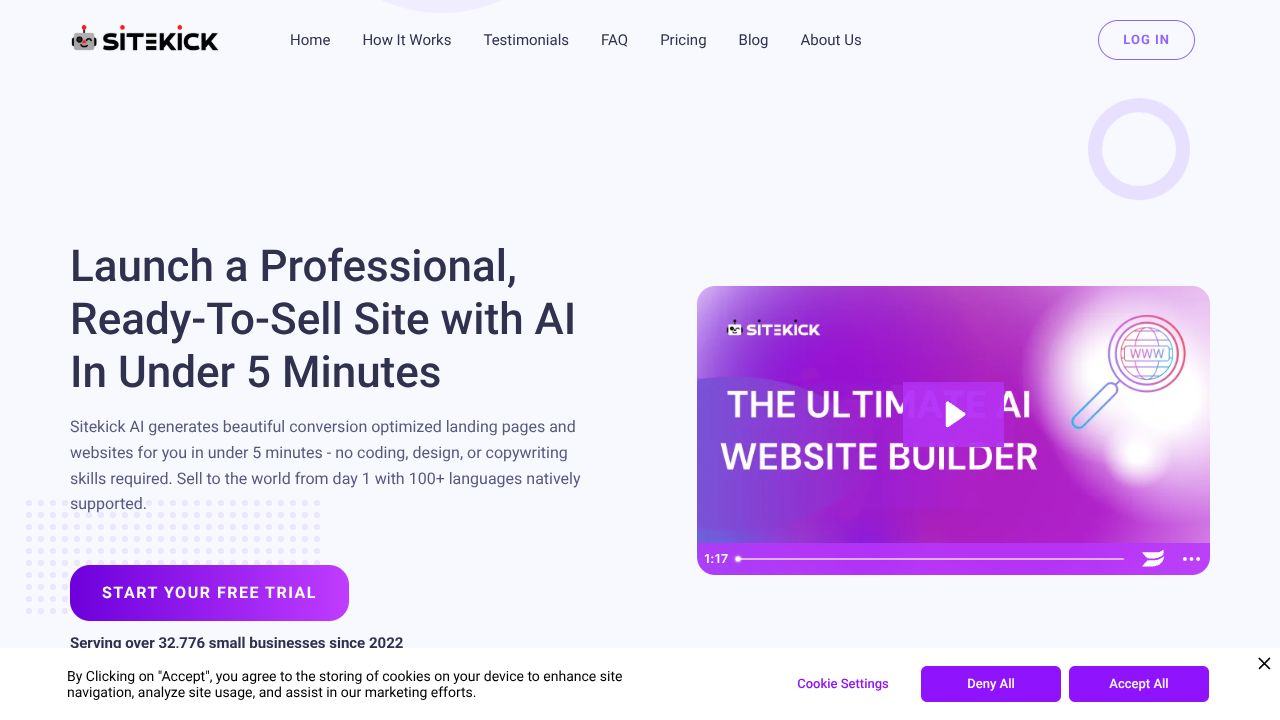
Picture this: it’s 9:10 a.m., your paid team has a new offer ready by noon, and creative is tied up for days. Every hour without a landing page burns budget and momentum. Sitekick AI (https://sitekick.ai) generates complete, on-brand landing pages—copy, layout, and images—in under five minutes. It matters because cycle-time is a competitive moat in digital. Bottom line: if your growth depends on rapid testing and time-sensitive activations, Sitekick AI compresses build time from days to minutes.
The Business Case
For marketing leaders, Sitekick AI is a velocity tool: faster launches mean more experiments per quarter, more shots on goal, and higher likelihood of finding winning offers. Our Strategy Analysis finds that the dominant ROI driver here isn’t the license fee; it’s cycle-time compression and the resulting increase in iteration volume. Replace 2–5 day build queues and ad hoc agency requests with a sub-5-minute page that is “good enough to test.” This unlocks a 5–10x increase in test cadence, which, in turn, raises the probability of hitting conversion-rate breakthroughs.
From a Positioning Breakdown perspective, Sitekick AI’s differentiator is full-page automation without technical lift. Where traditional builders demand design sensibility and CMS fluency, Sitekick produces usable assets for time-bound campaigns—product drops, event registrations, geo-targeted promos—where speed-to-market correlates with revenue capture. With digital interactions now dominating the buyer journey (see Gartner’s Future of Sales analysis: https://www.gartner.com/en/sales/insights/future-of-sales), an ability to stand up targeted experiences on demand becomes a structural advantage. The Brand Files thesis: use Sitekick to extend experimentation reach and protect paid efficiency during creative bottlenecks.
Key Strategic Benefits
-
Operational Efficiency: Sitekick AI reduces time-to-first-asset from days to minutes, removing design/development dependencies for net-new landing pages. Standardized, AI-driven layouts also simplify QA and reduce back-and-forth, enabling same-day go-lives and tighter media-to-creative alignment.
-
Cost Impact: By replacing ad hoc agency build-outs and internal rush work, teams can reallocate budget toward traffic acquisition or incentives. The unit economics improve when marginal page cost approaches zero; leaders should track cost per launch and cost per validated learning as core metrics.
-
Scalability: Rapid generation supports portfolio-level testing—multiple segments, offers, and geos in parallel. This scales experimentation without linear headcount growth and creates a reusable prompt/pattern library for faster subsequent deployments.
-
Risk Factors: AI-generated copy can drift from brand voice or compliance standards; governance and human review are non-negotiable. Additionally, templated pages may limit advanced CRO or SEO control; leaders should segment use-cases (speed-first vs. performance-max builds) and monitor Core Web Vitals to avoid performance drag.
Implementation Considerations
A pragmatic rollout follows a 30–45 day pilot. Week 1: Set guardrails—brand voice prompts, legal/compliance checklists, and approval SLAs. Week 2: Integrate analytics (GA4), pixels (Meta, Google, LinkedIn), and CRM/MA via native forms or Zapier/webhooks (e.g., to HubSpot or Marketo). Week 3–4: Execute 10–20 controlled launches across use-cases (flash promos, event sign-ups, partner co-marketing), measure against a pre-pilot baseline.
Resourcing: one performance marketer (owner), one brand/content reviewer (governance), and one marketing ops lead (tracking and integrations). Instrumentation: ensure UTM standards, event schema, and page performance thresholds (LCP <2.5s, CLS <0.1) are enforced. Change management: publish a “rapid page” playbook—approved prompts, image guidelines, QA checklist, and escalation paths. Data discipline is crucial: compare conversion rate, CPL, bounce rate, and time-to-launch vs. historical medians. Use a holdout where possible to isolate lift from speed-to-market versus offer quality (see HBR on experimentation rigor: https://hbr.org/2017/09/the-surprising-power-of-online-experiments).
Competitive Landscape
In Positioning Breakdowns, Sitekick AI’s superpower is speed with zero required skills. Alternatives emphasize different trade-offs:
- Framer AI (https://www.framer.com/ai/): design-forward polish, stronger for brand-led sites; slower to “first test.”
- Durable (https://durable.co/ai-website-builder) and Mixo (https://mixo.io): rapid SMB MVPs; lighter on CRO controls.
- Wix ADI (https://www.wix.com/adi) and Webflow AI (https://webflow.com/ai): deep ecosystems; require more configuration for experimentation velocity.
- Unbounce Smart Builder (https://unbounce.com/product/smart-builder/) and Instapage (https://instapage.com): robust testing and post-click optimization; more setup time.
For market scanning and Campaign Reviews, see category comparisons on G2 (https://www.g2.com/categories/landing-page-builders) and Capterra (https://www.capterra.com/landing-page-software/). Sitekick’s edge is fastest time-to-asset; its trade-off is fewer enterprise-grade governance and experimentation features out of the box.
Recommendation
Adopt Sitekick AI as a “rapid-deploy lane” alongside your premium build workflow. Run a 30-day pilot targeting 15–25 launches with clear success criteria: median time-to-launch under 30 minutes, +3–5x experiment volume, stable or improved CPL/CVR versus baseline. If thresholds are met, formalize usage for time-sensitive campaigns, codify governance, and integrate with CRM/MA. Preserve high-touch builds for brand-critical pages; use Sitekick to protect paid efficiency and capitalize on fleeting demand windows. This is Strategy Analysis in action: speed as a measurable moat.